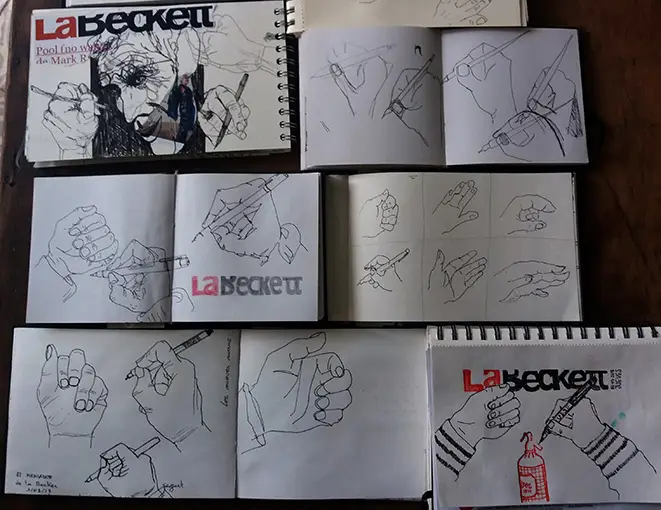
Discover techniques and tricks to learn to draw hands in a playful way.
Drawing hands is a fascinating topic that has frightened more than one artist throughout history.
A master in this art was Albrecht Dürer (15th century). In addition to drawing, he made engravings that influenced many artists, including the German Expressionists of the early 20th century. In his paintings and drawings, his hands seem real.
Hands, therefore, are a source of unlimited inspiration.
In most tutorials, the teaching of hand drawing is very academic. After 10 minutes, we may have gotten bored with our hand extended over the table. We would have learned that the hand is located on the end of our arm, it has 5 fingers, but we already knew that.
Do you need to have knowledge of anatomy or medicine to draw hands?
With some basic rules like sharpening our sense of observation and daring to try new things, hand drawing can become a fun game, an inexhaustible topic to experiment with techniques and tools, rather than a battlefield that has discouraged many.
1- To begin with, we must concentrate and learn to see, or rather to observe, our hand.
2- Then try to forget that we are drawing a hand, and how complicated it can be, to focus on the shape we see.
3- Likewise, before starting to draw, we will try to understand how this shape is constructed. Once all these conditions are met, we can already start drawing.
4- And we will do it from the general shape to the detail. That is, once the shape of our hand is drawn, we will fill the inside with the details we see.
And we will continue our hands exercise, exploring different techniques, such as the continuous line (drawing without lifting the marker from the paper), drawing without looking at our sketchbook (this method encourages hand-eye coordination), drawing with the opposite hand (inviting a clumsy but expressive line), or drawing with 2 hands, etc.
The important thing is to experiment.